Jail Accreditation
General Information
The accreditation process offers the opportunity to evaluate operations against national standards, remedy deficiencies, and upgrade the quality of correctional programs and services.
The Cherokee Sheriff's Office participates in three accreditation processes with the American Correctional Association (ACA), National Commission on Correctional Health Care (NCCHC), and the standards established by the National Prison Rape Elimination Committee (NPREC). The United States Department of Justice passed the Prison Rape Elimination Act in 2003 (PREA). In order for correctional facilities to be considered compliant, they are required to be audited by certified Department of Justice auditors every three years.
The Cherokee Sheriff’s Office has been participating in the NCCHC accreditation process since 2004. The Cherokee Sheriff’s Office has since received compliance every three-year audit cycle since then, and our most recent re-accreditation was awarded in April of 2023. The next audit will take place in April 2026.
In August of 2019, the Cherokee Sheriff’s Office achieved its first accreditation with the American Correctional Association. This achievement was the final step for Cherokee Sheriff’s Office to reach “Triple Crown” status. The Triple Crown is awarded by the National Sheriff’s Association and is a prestigious honor with less than fifty sheriff’s offices in the United States holding the title.
The Cherokee Sheriff’s Office has since received compliance on each audit cycle since the initial accreditation earning a perfect score on our most recent re-accreditation audit that took place April 21-23, 2025. The next audit will take place in April of 2028. The Cherokee Sheriff’s Office has been participating in the PREA audit process since 2014. The most recent re-accreditation audit for PREA took place from June 26-28, 2024. The next PREA audit will take place in June of 2026.
 |
 |
 |
Accreditation Letter
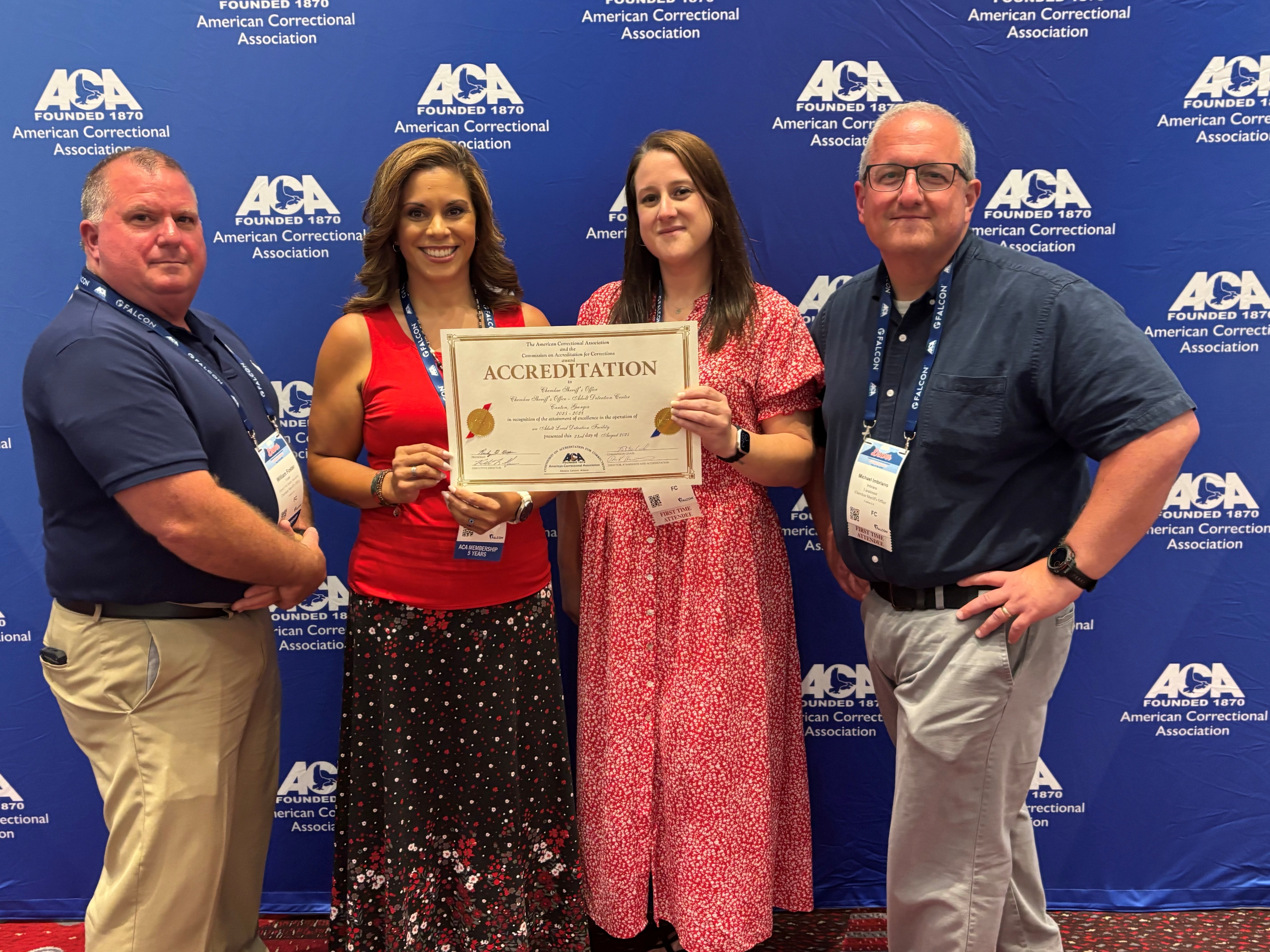
Cherokee Sheriff's Office staff at the American Correctional Association Conference in Denver, CO to receive our re-accreditation award on August 23, 2025. Pictured from Left to Right Deputy Paul Foster, Captain Irene Ruiz, Ashley Ray – Jail Accreditation Manager, and Lt Michael Imbriano.
ACA Reports
There are several benefits to maintaining A.C.A. accreditation. It ensures that best practices in the Adult Detention Center are being followed, creates a safer environment for employees and inmates, can reduce insurance premiums for the agency, and improves staff morale and professionalism.
The C.S.O. received a perfect score of 100% on both the A.C.A. mandatory standards and the A.C.A. non-mandatory standards for 2022.
Please click to download the ACA reports below:
2025 ACA Report2022 ACA Report
2019 ACA Report
Resources
CSO PREA
In 2003, the United States Department of Justice (DOJ) passed the Prison Rape Elimination Act (known as "PREA"),
in an effort to eliminate sexual abuse in correctional ('confinement') settings.
See all PREA Audits here.
Benefits of Accreditation
- Ensures compliance with nationally adopted standards
- Establishes guidelines for daily operations
- Reduces costly and time consuming litigation
- Improves community support
- Provides basis for enhanced funding
- Assesses our strengths and weaknesses
- Provides a system of checks and balances
- Builds staff/offender morale
- Safer environment for staff and offenders
- Ensures policies & procedures are current
- Promotes systematic review
- Clarifies expectations for staff
- Strengthens crime prevention and control capabilities
- Formalizes essential management procedures
- Establishes fair and nondiscriminatory personnel practices
- Improves service delivery
- Solidifies interagency cooperation and coordination
- Increases the efficiency of health services delivery
- Strengthens organizational effectiveness
Accreditation/Inspection Process
The accreditation/inspection process is a combination of "process" and "proof."
The Command Staff oversee the entire process to ensure compliance of the standards through the management of the Accreditation staff. However, it is the employees who work in the field that make the process successful.
Accreditation and inspections are a team effort. All employees and contracted service providers are committed to the process and understand the goals, objectives and reasons for maintaining our accreditation and passing our inspections. Employees and contracted service providers participate in training that teaches the importance of accreditation and inspections.
Employees are held accountable in the accreditation and inspection process. All employees are part of the process; however, only one individual is assigned to be ultimately responsible for a given outcome. A process is in place to ensure that this one individual is held accountable from "process to proof." This refers to the organization following the written standard and proving the standard with appropriate documentation through policy and procedure.
Our organization conducts a self-evaluation, and has a standards compliance audit by trained consultants prior to an accreditation or passing inspection decision for ACA and NCCHC by the Commission on Accreditation for Corrections. The initial process of accreditation normally takes 12 to 18 months to complete. Accreditation is granted for a period of three years; however, maintenance of accreditation is an ongoing task. Once accredited, the organization submits annual certification requirements.
The American Correctional Association (ACA) -
ACA is a private, non-profit organization that administers the only national accreditation program for all components of adult and juvenile corrections.
Accreditation, a process that began in 1978, involves approximately 80% of all state departments of corrections and youth services as active participants. Also included are programs and facilities operated by the Federal Bureau of Prisons, the US Parole Commission and the District of Columbia. The accreditation program offers the opportunity to evaluate operations against national standards, remedy deficiencies, and upgrade the quality of correctional programs and services.
The National Commission on Correctional Health Care (NCCHC) -
The Commission is an independent, not-for-profit organization committed to improving the quality of health care in jails, prisons, and juvenile confinement facilities.
The American Medical Association, in collaboration with other organizations, established a program in the early 1970's that later became the National Commission on Correctional Health Care. Their mission is to evaluate and develop policy and programs that help correctional and detention facilities improve the health of their inmates and the communities to which they return.